Category: Opinion

  • Azu Ishiekwene: We owe Putin an unreserved apology

    As U.S. President Donald J. Trump marks his first year in office by expanding his wish list from making Canada the 51st state of America to seizing and renaming the Panama Canal, and now taking Greenland by any means, if he cannot get the Nobel Peace Prize, spare a thought for Russian President Vladimir Putin. The world has been unfair to him.

    In one year, Trump has indulged in some of his tastiest treats from the world’s biggest candy stores, the most gratifying of which must be capturing Venezuelan President Nicholas Maduro and his wife, Cilia Flores. Trump even briefly announced himself as “acting president” after seizing control of the country, which has the world’s largest oil deposits.

    In 365 days…Trump’s first year in office must be making Putin wonder what he has done to be classified among the world’s most despised, with descriptions of him ranging from a tyrant and outlaw to a potential war criminal.

    In light of the wreckage that the world has now become, does Putin deserve to be viewed through a milder, gentler lens? Are his transgressions unforgivable?

    Putin’s sinsWhen the Russian president annexed Crimea 12 years ago, the world was outraged. The United Nations declared the annexation illegal, and the U.S. and Europe imposed limited sanctions on Russia. But Putin had only just started with Ukraine.

    He consolidated his grip on Crimea, arguing that the resort, which hosts Russia’s Black Sea Fleet, is strategically important to Russia and that its loss would weaken Russia’s naval position. And in case the world had forgotten, he reminded us that Crimea was a part of Russia until 1954, when it was transferred to Ukraine, which was then part of the Soviet Union.

    Cost of warIn Russia, Putin framed the annexation as a response to the historical injustice by the U.S. and Western Europe to emasculate, weaken, and encircle Russia. Putin defied Western economic sanctions, and eight years after annexing Crimea, he made an even more audacious move by launching an all-out war on Ukraine.

    In the last four years of the war, the estimated total casualty figures have ranged from 980,000 to 1.4 million, with civilian deaths as high as over 14,000, minus the wounded and millions more displaced. The Russia-Ukraine war is the bloodiest in Europe since World War II. Yet, there’s no end in sight, mainly because Putin insists that he won’t stop except Ukraine gives up territory currently occupied by Russian forces, a concession that President Volodymyr Zelenskyy is unwilling to make.

    Greenland by all means?Putin’s demands, as unreasonable and unjustified as they may be, have paled into insignificance since the scandalous demand by President Trump that the U.S. must have Greenland, by any means possible.

    If Trump believes that he can grab Greenland and plant the U.S. flag in Nuuk, whether the people like it or not, because he was denied the Nobel Peace Prize as he told the Norwegian Prime Minister Jonas Gahr Støre in a text message, why is Russia, which has an even more substantial stake in Ukraine, being condemned, ostracised and punished, while Trump gets ego massage?

    Putin has argued that the war with Ukraine is a matter of Russia’s survival, insisting that after the former Soviet Union broke up into 15 states, there was an agreement between President Mikhail Gorbachev and the West in 1990 that NATO would not expand eastward. That agreement has been widely cited in credible diplomatic circles.

    NATO has denied the existence of such an agreement, but has barely hidden its subversive encouragement in bringing three countries under the former Soviet Union into its fold, virtually encircling Russia. For Putin, the invasion of Ukraine is his last stand, his push, after Crimea, for Russia’s modern-day Danzig (the crucial trigger for World War

  • Christian Genocide: Where does Nigeria go from here? By Abdul Mahmud

    Christian Genocide: Where does Nigeria go from here? By Abdul Mahmud

    Nigeria enters this decisive moment carrying the weight of truths already laid bare. Last week’s conclusion made clear that the killings are known, the perpetrators identifiable, and the costs of silence intolerable. What confronts us now is what those realities mean for the future of Christians and for the survival of the Nigerian state itself. Violence against Christians has ceased to be an episodic failure; it has become a structural indictment of the nation’s moral and constitutional order. The massacres, displacements, razed villages, and desecrated churches are not isolated horrors but symptoms of a deeper corrosion at the heart of citizenship. When people are hunted on their farms, abducted from their homes, or driven from ancestral lands because of their faith, the injury extends beyond the dead and the displaced. It strikes at the very idea of equal belonging. A state that cannot protect life without discrimination forfeits legitimacy, and a society that normalises such loss fractures its social contract. Trust erodes. Rights become contingent. The promise of a shared future dissolves into fear. This concluding reflection, therefore, turns not merely to what has been endured, but to what lies ahead because a country that fails to act after recognition does not merely hesitate; it chooses decline.

    Our country stands at a perilous crossroads, where violence against Christians has ceased to be an aberration and has become a damning indictment of its very foundations. The killings, the displacements, the razed communities, and the gutted churches are not isolated tragedies. They expose fissures deep within Nigeria’s political and cultural identity. A nation cannot endure when its citizens are slaughtered for their faith while the state proves too weak, too unwilling, or too compromised to shield them. Murder is never only an attack on individuals; it is an assault on the constitutional framework that binds a nation together. When Christians are killed on their farms, abducted from their homes, or hunted from their ancestral lands, the reverberations extend far beyond the immediate loss. It signals that citizenship is tiered, that some communities enjoy the full weight of state protection while others are left exposed to predation. The legitimacy of the state, in any plural society, rests on its capacity to provide security without discrimination. Once that guarantee collapses, the victims are not only those whose lives are taken, but the entire polity that loses confidence in its institutions. Trust erodes, rights become negotiable, and the promise of a shared future dissolves into fear and deeper dangers.

    The greater danger lies in what such unchecked violence reveals about the internal architecture of the state. A country that allows targeted killings to persist is not merely failing in its duties; it is exposing a structural contradiction within its identity. When the state hesitates to act decisively, when perpetrators escape justice, and when whole communities are abandoned to violence, it becomes evident that the protection of citizens is filtered through political, religious, or cultural lenses. In such a context, the state no longer functions as an impartial guarantor of security; it becomes a contested arena in which competing identities dictate who lives safely and who does not. This is how nations slide from fragility into fragmentation: regions behave like quasi-sovereignties, non-state actors assert imperial authority, communities withdraw into self-help arrangements, and citizens redefine loyalties along ethnic or religious lines rather than national ones. A country in this condition is not only bleeding; it is drifting toward a future in which the centre can no longer hold. 

    The human cost of this drift is incalculable. Children grow up in fear, schools remain closed or destroyed, and families are torn apart, not only by loss but by the knowledge that justice is absent. Generations inherit trauma as a permanent legacy; their

    understanding of society is shaped not by the promise of protection but by the omnipresence of danger. Communities that should be hubs of culture, faith, and social cohesion become fortified enclaves, turning inward, wary of outsiders, and resigned to survival by any means necessary. Such a society loses the capacity for empathy, solidarity, and shared purpose—the very elements that sustain nations beyond mere geography. 

    The scale of the killings is staggering. The Observatory for Religious Freedom in Africa reports that more than sixteen thousand Christians were killed between 2019 and 2023. Thousands more were abducted. Entire villages in the North Central and North East regions have been emptied of their Christian populations. These figures are devastating not only because of their magnitude but also because they trace a pattern. What emerges is a slow, methodical, and relentless campaign of destruction. It is a genocide that moves quietly but persistently, consuming communities one village at a time. But numbers alone do not tell the story. What is unravelling is the idea of Nigeria itself. Violence of this scale is never the work of isolated criminals. It reveals a structural problem that Nigeria has refused to confront. Unless the country faces this truth now, its survival is not assured.

    Francis Deng, writing about Sudan decades ago, described a country divided not only by geography but also by identity. One part was shaped by a state that drew legitimacy from an Islamic ethos. The other part aspired to a secular and inclusive political order. Deng’s analysis was prophetic for Sudan, and it applies with an unsettling prophecy to Nigeria. Though Nigeria is wrapped in the same constitution, it houses two incompatible visions of statehood. One part of the country draws its political and cultural authority from religious identity. The other remains committed to a secular understanding of citizenship. These contradictory visions clash, collide, and ultimately undermine the cohesion of the country.

    Violence against Christians is one outcome of this unresolved contradiction. In regions where Islamic identity shapes political legitimacy, Christian communities often find themselves vulnerable. Their political voice is weaker. Their social standing is fragile. Their physical safety is never guaranteed. Their persecution becomes easier to rationalise and their sufferings easier to ignore. The state’s uneven response reflects this imbalance. Protection becomes selective. Justice becomes uncertain. Citizenship becomes unequal.

    The problem is deeper than a simple division between the North and the South. The northern region itself contains layered and conflicting identities. Dominant sects have persecuted Muslim minorities. Larger majorities have suppressed ethnic minority groups. Intra-Islamic tensions simmer beneath the surface and occasionally erupt. These tensions do not reduce the severity of Christian sufferings; they intensify it. A state that is fractured within its dominant bloc cannot guarantee neutrality across the entire federation. Without neutrality, the secular promise of the Nigerian Constitution collapses.

    The consequence is what we witness today. The country behaves as if it were two nations stitched together under a single flag. One is a secular republic on paper. The other is a state influenced heavily by religious identity. The result is paralysis. Where the identity of the state is contested, the protection of minorities becomes negotiable. Where citizenship is filtered through faith, equal belonging becomes impossible. This structural contradiction fuels impunity. Killers roam freely because, in the unspoken logic of a divided country, their crimes do not threaten it. They threaten only the other nation that exists within the same territory. When Christian villages are wiped out in Plateau, Kaduna or Benue, what is destroyed is not merely human life. It is the fragile belief that

    Nigeria operates as one collective political community, with every unpunished massacre that belief fades. With every displacement, the idea of national unity becomes a dream.

    When the idea eventually collapses, the consequences are predictable. Countries built on contradictory identities often break apart. Sudan did. Yugoslavia did. Ethiopia struggles under similar pressures today. Lebanon has lived for decades in suspended fragmentation. Nigeria is not immune. The displacement of millions, the rise of community self-defence networks, and the creation of religiously homogeneous enclaves all reflect a country drifting towards internal borders. These borders are not drawn on maps. They are drawn in fear and mistrust.

    So, whither Nigeria?

    If Christian communities can no longer live safely in regions where they have lived for generations, the question before us is not merely about human rights. It is existential. A country that cannot secure pluralism cannot secure unity. A country that cannot protect all citizens equally cannot endure. A country that refuses to confront its foundational contradictions becomes a country preparing for its own undoing. Protection must therefore move beyond rhetoric. Counting the dead without safeguarding the living is an illusion. Naming perpetrators without prosecuting them is complicity in slow motion. Calling for unity without addressing the identity conflict at the heart of the country’s existence is an evasion of responsibility.

    Nigeria must choose what kind of state it wants to be. Will it, in a real sense, remain a secular republic that protects all citizens regardless of their faith? Or will it evolve into a country where religious identity determines safety, legitimacy, and belonging? The fantasy that both models can coexist indefinitely is collapsing under the weight of graves. Christians cannot wait for theoretical clarity while facing annihilation. They need security now. They need justice now. They need full and equal citizenship now. Anything less pushes Nigeria towards a point where coexistence becomes impossible.

    The question of whither Nigeria is not an academic one. It is urgent. Either the country confronts its dual identity and commits politically and constitutionally to a secular and protective state, or it continues down a path where violence becomes the language through which unresolved identity conflicts are expressed. At the end of that path lies fragmentation.

    Many countries of the world survive not by proclaiming unity but by protecting it. If Nigeria fails to safeguard its Christian citizens, it is failing its own constitutional promise. It is also abandoning the very idea of itself as a plural and democratic state. The future of the country depends on whether it can confront the truth of its divided identity and build a state where no citizens fear for their lives because of faith. Nigeria stands at a crossroads. One path leads to renewed protection, deeper inclusion, and national cohesion. The other leads to distrust, division, and eventual disintegration. The choice is clear. Leadership must rise to the moment. Accountability must be enforced.

    Citizens must insist on equal protection. The survival of Nigeria depends on it. If Nigeria is to survive as a unified polity, the path forward requires more than acknowledgement; it demands decisive, structural action. Security cannot be outsourced to occasional interventions or limited religious advocacy alone. The state must reaffirm its monopoly on the legitimate use of force, ensuring that no citizen lives under the shadow of impunity. Institutions must operate impartially, justice must be swift and visible, and the machinery of governance must be rebuilt on the principle that protection is a right, not a privilege. Without this, the cycle of violence will not merely continue—it will accelerate, eroding the bonds that hold society together. The future of Christians in Nigeria, and indeed the future of Nigeria itself, depends on the courage to confront this reality today before it becomes irreversible tomorrow.

    Whither Nigeria?

    Abdul Mahmud, a human rights attorney in Abuja, writes weekly for The Gazette

  • Explainer: Did Nigeria act legally by sending fighter jets into Benin?

    Explainer: Did Nigeria act legally by sending fighter jets into Benin?

    By Bayo Wahab

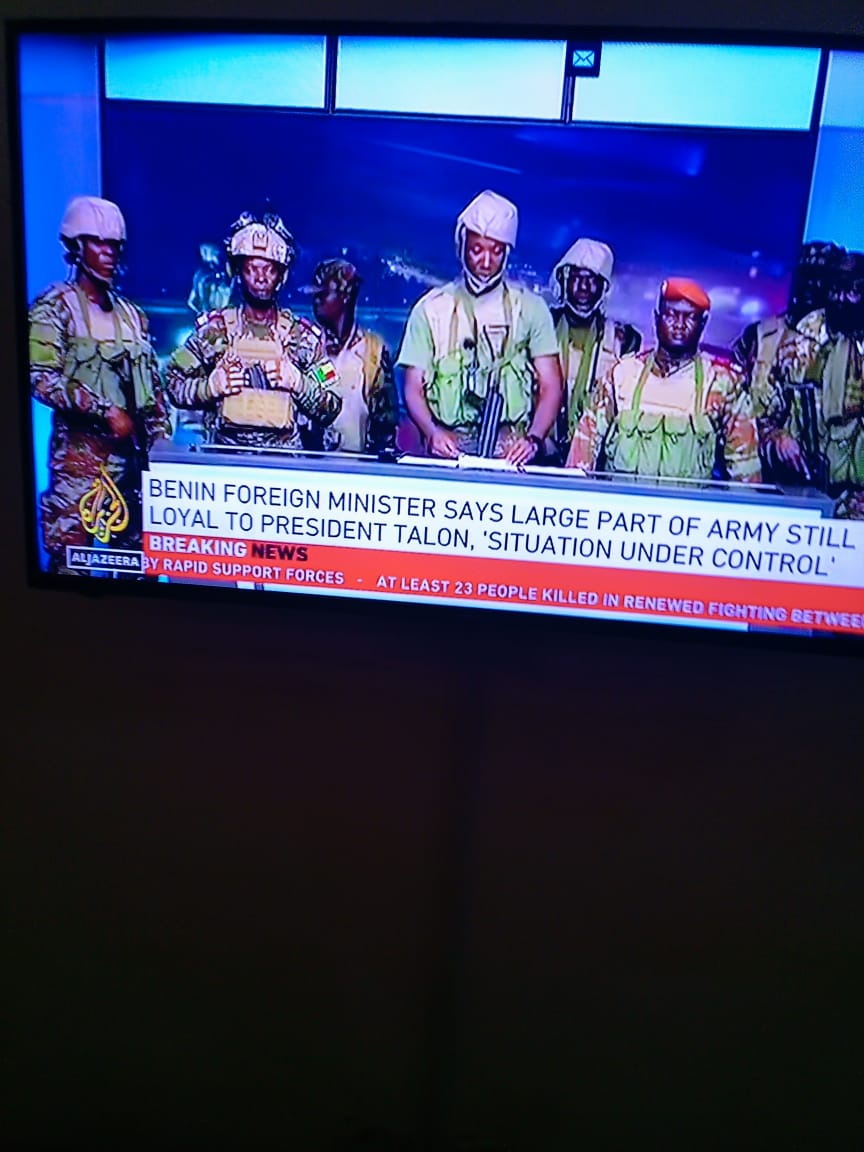
    Nigeria’s military operation in the Benin Republic, following Sunday’s failed coup attempt, has sparked questions among Nigerians about whether President Bola Tinubu had the legal right to deploy fighter jets into a neighbouring country.

    Nigeria’s fighter jets took over Beninoise airspace after a group of soldiers calling themselves the Military Committee for Refoundation appeared on national television claiming to have seized power and removed President Patrice Talon.

    The coup collapsed within hours, with authorities confirming that 13 soldiers, including the masterminds, were arrested.

    But as news of Nigeria’s involvement spread, social media claims alleged that President Tinubu “bombed” Benin on the orders of French President Emmanuel Macron, who was reported to have spoken with Nigeria’s President earlier on Sunday.

    Benin Requested Nigeria’s Assistance — Presidency

    Contrary to the social media claims, the presidency said Nigeria’s action in Benin was not haphazard.

    In a statement signed by presidential spokesperson Bayo Onanuga, the Federal Government said it acted strictly on the Benin Republic’s official request for immediate military support.

    The statement read in part: “Acting on two separate requests from the Government of Benin, President Tinubu ordered Nigerian Air Force fighter jets to enter the country and take over the airspace to help dislodge the coup plotters.”

    Onanuga said Benin’s Ministry of Foreign Affairs sent a note seeking urgent air support “to safeguard constitutional order and ensure the security of the population.”

    “In the second request, the authorities in Benin requested the deployment of Nigerian Air Force assets within Beninoise airspace for surveillance and rapid intervention operations under Benin-led coordination,” the Presidency said.

    According to the statement, the Benin government also requested Nigerian ground forces, “strictly for missions approved by the Beninese Command authority in support of the protection of constitutional institutions and the containment of armed groups.”

    So, was Nigeria’s intervention legal?

    Generally, under international law, a country cannot deploy military assets in another sovereign state except under specific conditions.

    Article 51 of the United Nations Charter recognises the right of self-defence as a fundamental right.

    The article states: “Nothing in the present Charter shall impair the inherent right of individual or collective self-defence if an armed attack occurs against a Member of the United Nations, until the Security Council has taken measures necessary to maintain international peace and security.

    “Measures taken by Members in the exercise of this right of self-defence shall be immediately reported to the Security Council and shall not in any way affect the authority and responsibility of the Security Council under the present Charter to take at any time such action as it deems necessary in order to maintain or restore international peace and security.”

    Furthermore, another legal basis for military intervention is enshrined in Article 25 of the Lomé Protocol of the Economic Community of West African States. (ECOWAS).

    This legal framework allows ECOWAS to intervene militarily in its member States in a number of situations, including the case of military coups.

    The article also implies that among ECOWAS States, the use of military force is permissible when a State invites another State or the regional organisation to use force on its territory.

    Under what circumstances can a country invade another nation militarily?

    While Article 51 of the UN Charter provides a legal basis for states to use force in self-defence, Article 25 of the Lomé Protocol specifically grants ECOWAS the legal basis to militarily intervene to maintain peace and order.

    However, experts generally outline three scenarios under which a country can invade another country militarily.

    1. Intervention by invitation

    A sovereign state may request external military assistance. Once such a request is made, the assisting country is legally permitted to operate within its territory.

    1. War

    During a declared war between two countries, a military invasion is justified, though it would come with significant diplomatic consequences.

    1. United Nations authorisation

    The UN Security Council can mandate military intervention in cases of threats to international peace.

    In this case, both Nigeria and the Republic of Benin are ECOWAS members, and both countries agreed to the Lome Protocol signed in Togo in December 1999.

    Nigeria’s military operation in the francophone country falls under the intervention by invitation framework, since the Benin Government officially invited its support to repel the coup attempt.

    This makes the deployment lawful under international norms and bilateral security cooperation frameworks between ECOWAS states.

    Whether Nigeria’s intervention in the Republic of Benin has moral foundation, given the security situation at home, is another matter entirely.

  • Abdul Mahmud: Governor Amuneke is who he is

    His is not just ordinary commentary. It is a political satire. A mirror held up to our country, its rulers, people and  politics. His is the art of laughter and lament. Kevin Arua, who goes by the nom de guerre, Kevin Black, and the popular Governor Amuneke, an online voice that exposes folly, mocks power, and makes us laugh even when the truth hurts, has in a short time become the symbol of our country’s contemporary satire. 

    But, satire isn’t art for art’s sake. In its purest form, it is an act of rebellion. It unsettles authority. It questions the absurd. It mocks the powerful and shakes citizens out of apathy. From Aristophanes to Jonathan Swift, from George Orwell to Adeola Fayehun, the satirist has always been a moralist in disguise. 

    Governor Amuneke continues that tradition. He takes our country’s madness and turns it into an art form, showing us the dim wards of our national asylum, where we shuffle about as bedraggled inmates, muttering gibberish to ourselves and mistaking decay for destiny. 

    In that asylum, corruption wears the white coat of competence, and failure parades as reforms. We are patients and attendants at once trapped in a cycle of madness we no longer recognise as madness.

    Governor Amuneke’s satire holds up the mirror to this condition. He shows us our deranged laughter, our absurd routines, our surrender to mediocrity dressed as governance. His art forces us to see that the asylum is not just political, it is moral, social, and psychological. It is the place where we have learned to live with delirium, where outrage has become therapy, and where laughter is the only medicine left to dull the pain of citizenship.

    He makes us confront the terrifying normalcy of dysfunction. The roads filled with potholes and the endless excuses that make for the theatre of the insane. Yet, even in this theatre, he insists on laughter, not as escape;  but as illumination. His genius is that he makes us laugh while showing us the tragedy of who we have become: a country clapping for its tormentors, applauding decay, and electing jesters to preside over ruins. His satire, in the end, is not a shield for inaction.

    Political satire has always been a weapon of the powerless. In our virtual spaces, whether it is TikTok, Instagram, or X (formerly Twitter), it has become the people’s parliament. When institutions fail, when the legislature becomes a bazaar of self-interest, and when the judiciary is on its knees, satire takes over. It becomes the only safe way to speak truth to power. Governor Amuneke has mastered that. He uses humour to reveal our collective tragedy. He makes us laugh at the same people who make us cry. The world he creates is fictional; but the fiction is only a mask. Behind his parodies lies the sharp edge of truth. He caricatures politicians who speak of “renewed hope’ while presiding over despair. He mocks officials who celebrate failure as progress. He exaggerates reality to the point where it becomes impossible to ignore. That is the genius of satire; it hides its fury behind laughter.

    Scholars have long recognised satire as a political act. Mikhail Bakhtin, the Russian theorist, saw it as a form of the “carnivalesque”, where the world is turned upside down and the lowly ridicule the mighty. In our country, where governance is often theatre, satire becomes the theatre within the theatre. Governor Amuneke performs in this second stage, using the tools of mockery, exaggeration, and irony to make our country visible in all its absurdity. 

    Regardless, it is important that we do not conflate satire with nihilism. Satire is never mockery for its own sake; it uses laughter as a mirror, not a weapon while exposing folly so that reform may begin. Governor Amuneke may joke, but the joke is not idle. Every punchline conceals a question: why are things the way they are? Why do we tolerate incompetence? Why do we

  • PENGASSAN, DANGOTE, AND THE PERILS OF UNCHECKED CAPITALISM IN NIGERIA’S OIL SECTOR: WHY PROTECTING UNIONISM MATTERS

    By Olatunde Olayinka Damillola

    It has always been ASUU but this time it is PENGASSAN, an acronym for Petroleum and Natural Gas Senior Staff Association of Nigeria (PENGASSAN). On the 28th of September 2025, PENGASSAN ordered a nationwide strike, directing the interruption of gas supplies to Dangote refineries, in response to the dismissal of 800 Nigerian workers by the refinery.

    In the wake of this news, several opinions have trailed the actions of PENGASSAN and Dangote refinery, especially the impact of the strike on the masses who depends on processed petroleum product from Dangote refinery. It is with similar concern, that I have decided to view this melodrama between the disputing parties from a socio-legal perspective.

    PENGASSAN in its press release alleged that the dismissal of 800 workers from Dangote refinery was an act of victimization, following the voluntary admission of these workers as members of the trade union.

    Although ,this claim was denied by DANGOTE, it would be logically berating not to establish a sufficient link between the dismissal of these workers and there recent membership of the union, especially since on 15th September 2025 the same refinery had a similar fisticuff with NUNPENG on the issue of unionism among its workforce of tanker drivers and other employees, which was settled by a peaceable but yet unconstitutional agreement.

    Believing PENGASSAN’s claim to be true, it is my opinion that the dismissal of 800 workers for voluntarily joining a trade union falls short of provided constitutional safeguards on human right and labour protection. A conjunctive reading of section 40 of the Nigerian Constitution 1999 and section 12(4) of the Trade Union Act (Amendment Act) 2005, entitles every person or workers to assemble freely and associate with other persons to form or belong to trade union for the protection of their interests without victimization.

    The dismissal of these persons for joining a trade union therefore is a disrespect to human right and labour law under the law.Moreover, while the excuse of economic and national stability concerns have been given severally by Dangote refineries for its attitude towards trade unionism, which in my opinion are genuine; knowing that Dangote refinery is significantly a national asset, although privately owned, and that union activities can sometimes have disruptive effects, it is important that the welfare of workers and the interest of consumers are nonetheless adequately protected through unionism in order to also avoid the danger of unchecked capitalism.

    Dangote refinery currently positions as a private monopoly in a country where state owned refineries are very dysfunctional.

    The implication of this strategic trade positioning therefore accrues so much control to the refinery over both the consumers and its workers. Therefore unionism is a necessary evil that must be allowed in order to avoid the dangers of arbitrary capitalism.

    To further crystalize this point, it is my opinion that the dismissal of over 800 workers on the ground of “re-organization” exemplifies the refinery’s poor approach towards its workers job security.

    When 800 workers are thrown out of their job in an already escalating pandemic of unemployment and attendant insecurities in the country, it exercabates labor tension and puts the nation in socio-economic jeopardy.

    This singular act makes an excellent practical reason why trade unionism is necessary to protect the interest of the workers at the refinery in order to ensure adequate welfarism and also afford room for collective representation during trade disputes. In totality, the dismissal of 800 workers, even though it aligns with the right of an employer to hire and fire under common law, in my opinion constitute an act of modern slavery and abuse of monopolistic influence in this situation; the danger of unchecked capitalism. The exercise of right to unionism should be negotiated by Dangote refinery and not proscribed with forceful dismissals and scapegoating.

    Meanwhile, not to throw the baby with the bathe water, it is also my opinion that PENGASSAN’s purported industrial actions are one which will not only hurt Dangote’s business but the masses. Suppliers of gas and crude prohibited by PENGASSAN directive of 27th of September are in essential service not to just Dangote Refinery but the nation as a whole. Section 48 of the Trade Dispute Act (First Schedule) classifies services in connection with the supply of fuel, whether owned by the government or private entities as essential services and disputes between players in these areas have specialized procedures to it, one which PENGASSAN must take notice of and comply.

    Section 41 of the Trade Dispute Act especially requires that a notice of at least fifteen days must be given in case of an industrial action by persons in essential services. It is my opinion, that while the relationship of suppliers of gas with Dangote Refinery is not that of an employment but a contractual agreement, an action by gas suppliers in furtherance of a trade dispute in the interest of PENGASSAN will sufficiently bring it within the purview of this law. So far, PENGASSAN has failed to give sufficient notice and would be advised to rethink their action and consider issuing a proper notice in compliance with the law on trade dispute. An eye for an eye they say would make the whole world blind, lawlessness has never been an answer to lawlessness.

    Furthermore, it is desirable in the interest of the nation that the Minister for Labour wade into the trade dispute. Section 17 of the Trade Dispute Act permits the Minister to apprehend labour disputes of this kind by referring it to the National Industrial Court or an arbitration panel.

    It is recommended especially that this dispute is apprehended over a round table where adequate settlement can be reached between both parties. If this fails, the parties should consider resolving this dispute by a speedy process using arbitration or a court hearing that would give the trial of the dispute an accelerated hearing.

    Overall, while the PENGASSAN dispute and industrial action is a necessary evil to uphold worker’s right against oppressive policies, not so uncommon in most private sectors in Nigeria, and stop the situation of unchecked capitalism in Nigeria, the consequences of these dispute if not speedily resolved is one that might plunge the nation into dire economic repression owing to the most sector’s dependence on petroleum.

    It is therefore desirable that this dispute be settled amicably and timeously, of course, with one important outcome; that the right to association of the dismissed 800workers are not placed at the mercy of the crunching boots of unchecked capitalism.

    Olatunde Olayinka Damilola is a public interest lawyer, with Tope Temokun Chambers.

  • 2027 Election: Options Before the North

    2027 Election: Options Before the North

    Vanguard News


    …Region faces tough choice over Tinubu, Jonathan, Atiku, Obi, Amaechi

    Clifford Ndujihe, Politics Editor

    THE North as a political bloc has a tough decision to make regarding who it will back in the 2027 presidential election, as no fewer than five politicians are on its radar for endorsement.

    The five leading politicians hoping to get the nod of mainstream North, including incumbent President Bola Tinubu; former Vice President Atiku Abubakar; former President Goodluck Jonathan; former Anambra State Governor, Mr. Peter Obi; and former Rivers State Governor, Mr Rotimi Amaechi.

    Although some northerners are considered to be eyeing the Aso Rock top seat, key stakeholders contend that a northerner succeeding President Tinubu will hurt the North-South power-rotation principle and create instability in the polity.

    Northerners interested in the presidential seat in 2027 include former Vice President Atiku Abubakar and former Presidential Candidate, Mr Gbenga Olawepo-Hashim. The likes of former Kano State Governor, Senator Musa Kwakwanso and Bauchi State Governor, Senator Bala Mohammed, are potential aspirants.

    However, to maintain stability in the polity, Vanguard gathered that some northern stakeholders, who are bent on stopping Tinubu, are shopping for a good Southern candidate who will serve a term and quit.

    This understanding, Vanguard gathered, is behind the push for former President Goodluck Jonathan and the move is presenting tough nut for the northern bloc to crack, as there is no unanimity yet on who to support among four leading potential southern candidates.

    The four candidates on the radar of many power brokers in the north are President Tinubu; former President Goodluck Jonathan; former Anambra State governor and 2023 presidential candidate of Labour Party, LP, Mr. Peter Obi; and former Rivers State governor, and Transportation Minister, Mr. Rotimi Amaechi.

    Among the quartet, Tinubu and Jonathan cannot do more than four years. Obi and Amaechi can seek re-election in 2031 for a second term, if elected.

    However, to maintain the power-rotation principle, Obi and Amaechi have pledged to do one term, a pledge that is still raising dust in the polity.

    With some dismissing the one-term promise as rhetoric that could be discarded as witnessed among political leaders in the past, most of the power brokers resolved to go for certainty instead of uncertainty.

    According to them, power must return to the north in 2031. The only way to guarantee that is ensuring that the next southern president does only four years. This leaves Tinubu and Jonathan as the two topmost options.

    Tinubu
    Against the plot of some politicians, especially from the north, President Tinubu prevailed in the All Progressives Congress, APC, presidential primaries and went on to win the 2023 poll, fending off a tough challenge from Atiku and Obi.

    He polled 8.79 million votes; Atiku got 6.9million votes while Obi scored 6.1million votes. The courts ratified Tinubu’s election as declared by the Independent National Electoral Commission, INEC.

    However, two years into his administration, the north is divided over the performance of the President. While some said he had done well and deserved to be handed another mandate, some northern leaders have accused President Tinubu of marginalising the north in terms of appointments, budgetary allocation, projects and infrastructural developments, and vowed to stop his re-election in in 2027.

    Supporters of the president in the north, including governors, Secretary to the Government of the Federation, SGF, Senator George Akume; ministers and appointees, have pledged their support for Tinubu and outlined the things he had done for the north in two years, which they argued outweighed what late President Muhammadu Buhari did in eight years.

    However, others, including Alhaji Atiku Abubakar, former Kaduna State governor, Malam Nasir el-Rufai; Senator Aminu Tambuwal, Governor Bala Mohammed insist otherwise, saying apart from marginalising the north, Tinubu’s reign had unleashed unbearable hardship and suffering on the citzenry of which northerners are worse off.

    Of Tinubu’s 8.79 million votes in 2023, more than five million came from the north, with the north-west contributing over 70 per cent.

    His aggrieved northern critics said his footprints in the north were not commensurate with their massive support, hence the need to look elsewhere in 2027 to halt the hardship.

    In response to the North’s complaints, the Tinubu administration, last week held an engagement with northern citizens in Kaduna where government officials led by Akume and Isa Bagudu outlined the president’s achievements in the region while listening to their grievances. Going forward, Tinubu may align with former Kano Governor, Senator Musa Kwankwaso to get the support of a major block in the North-West.

    Will Tinubu’s opponents beat his supporters in the battle for northern votes? Will Tinubu address the grievances of the north in the next 460 days before the February 20, 2027 presidential poll to swing the support of critical Northern mass to his side? These are some of the questions that will shape the outcome of the 2027 election.

    Jonathan
    Although, controversy is trailing his eligibility to run in 2027, following the 2018 constitution amendment that bars anyone that had been sworn-in twice from contesting the presidency, Vanguard gathered that Jonathan is gradually becoming the beautiful bride among some top northern power brokers, who see him as the best bet to defeat Tinubu in 2027.

    Jonathan was vice to the late President Umaru Yar’Adua. Following the National Assembly’s Doctrine of Necessity, he was sworn-in to complete Yar’Adua’s term in 2010.

    Thereafter, he contested in 2011, won and was sworn-in again. He sought a second term in 2015 and lost to late President Muhammadu Buhari, who ran on the card of the APC.

    Buhari’s victory was the first time an opposition candidate was beating an incumbent president in the history of electioneering in Nigeria.

    Those who worked against Jonathan in 2015 said, among others, that he should not have contested to allow power return to the north because after President Olusegun Obasanjo, a southerner ruled for eight years, Yar’Adua, a northerner, was in the saddle for two years.

    So allowing Jonathan to continue till 2019 would mean power being in the south for 18 years out of 20 years of democratic rule. Besides, they said Jonathan was a signatory to the power rotation agreement in the PDP, which he reneged on.

    However, given the “stop Tinubu” project, sources said Jonathan has emerged as a top contender within PDP, with many leaders declaring their readiness and willingness to give him the party’s ticket.

    A source said apart from his performance as a leader, his concession of power to Buhari after the 2015 tight election, instead of dragging the nation through tension-soaked litigation like most presidential candidates had been doing since 1999, earned him a soft-spot in the hearts of many northerners.

    This was one of the reasons he had cordial relations with Buhari after leaving power.

    Faced with dearth of strong contenders, following the defection of Atiku to the coalition-backed African Democratic Congress, ADC, Vanguard gathered that many PDP top shots have signed into the “Bring back Jonathan” project, wooing him to accept to run.

    PDP Deputy National Publicity Secretary, Ibrahim Abdullahi, confirmed the development, hinging the move to growing public nostalgia for Jonathan’s leadership style.

    He said many Nigerians, including former critics, now agree that Nigeria had a more stable and democratic era under Jonathan.

    “Even those who criticised him while in power are now admitting they were wrong. They’re asking for his forgiveness and urging him to return because they now recognise his values,” Abdullahi said.

    He recalled and described Jonathan’s peaceful concession in 2015 as a defining moment of statesmanship.

    “When he lost, he could have rigged the result in his favour, but he said no Nigerian’s blood was worth his ambition. That is the leadership Nigerians are yearning for—not just PDP members,” he said.

    According to Abdullahi, some PDP top brass have met Jonathan to persuade him.

    Vanguard gathered that a series of such meetings and consultations have been held abroad and Nigeria and more are afoot in the days ahead.

    Obi, Amaechi
    Obi, without “structure” as opposed to his opponents, ran a good race in 2023 and lost to Tinubu and Atiku.

    Since the end of the election, Obi has remained visible in the polity, touring all parts of the country and carrying out philanthropic gestures.

    Although he is still a member of the factionalised LP, he is one of the leading politicians promoting the ADC coalition.

    Others with him in the coalition are Atiku, El-Rufai, Tambuwal, and Amaechi, fuelling speculations that their individual presidential ambitions might harm the coalition.

    However, the quartet have dismissed the fears as unfounded, saying their goal is to rescue Nigeria from the iron-grip of Tinubu and APC and ensure good governance in the country.

    They added that they would back any one of them that emerged as ADC’s flagbeaber.

    While still on the coalition push, the PDP initiated moves to have Obi, who left the party in 2022 to return to the party, where he was vice presidential candidate to Atiku in 2019.

    Obi confirmed the move and said he was open to discussions that would protect the interest of the country.

    In the 2023 election, Obi won 11 states and the FCT. He won 10 southern states apart from Rivers. He also won a state in the north-central zone.

    Last week, Professor Jerry Gana said with Obi as PDP presidential candidate, the party would win the North. However, this though appears to be changing with the upswinging push for Jonathan.

    Amaechi as transportation minister, carried out many projects in the north, including the rail line from Nigeria to Maradi in Niger Republic. He also took a transport university to Daura and was honoured with a chieftancy title,

    In the 2023 primaries of the APC, Amaechi came second to Tinubu and harvested his votes from many northern delegates.

    Like Obi, Amaechi has promised to do a term if elected. With the latest push for Jonathan, it is to be seen if the core northern bloc will back Obi or Amaechi.

    Atiku
    Arguably Nigeria’s oldest presidential aspirant, who has been seeking the presidency since 1993, Atiku is one of the options before the North. He recently left the PDP for the ADC. He has also promised to do one term. If he picks the ticket, it will be his fourth time of being a presidential candidate dating back to 2007 (Action Congress, AC); 2019 (PDP); and 2023 (PDP). He sought the APC ticket in 2015 and lost to Buhari.

    In the 2023 election, Atiku won his native North-East but lost North-West and North-Central to Tinubu. It is to be seen if he can rally votes from the North and make inroads in the South to land victory in his seventh attempt.
  • A Medal of Loyalty: Ambassador Lawal Kazaure and the Unwritten Code of Service by Saleh Farouq Gagarawa

    A Medal of Loyalty: Ambassador Lawal Kazaure and the Unwritten Code of Service by Saleh Farouq Gagarawa

    A Medal of Loyalty: Ambassador Lawal Kazaure and the Unwritten Code of Service

    By: Saleh Farouq Gagarawa

    In the corridors of global diplomacy, protocol officers often operate behind the scenes ensuring that the wheels of statecraft turn smoothly, that dignitaries are honored, and that national prestige is preserved with every handshake and reception. But in the case of Ambassador Lawal Abdullahi Kazaure, Chief of Protocol to the late President Muhammadu Buhari, his role transcended ceremonial duties. He redefined what it means to serve not just a President, but a leader, a nation, and a legacy.

    The Unwavering Shadow of Loyalty

    Ambassador Lawal Kazaure’s name became synonymous with loyalty, discretion, and sacrifice throughout the Buhari era. For over a decade, he walked ahead of late President Muhammadu Buhari literally and figuratively guiding state protocols, but more importantly, safeguarding the dignity and honor of Nigeria’s first citizen. His service was not transactional; it was deeply rooted in conviction, personal integrity, and an understanding of the gravity of his office.

    He was more than a Chief of Protocol; he was a sentinel. His loyalty could not be bought, and in a world where personal gain often overshadows public service, Kazaure stood out as a beacon of unshakable fidelity. Presidents across Africa and beyond envied late Buhari for having such a man in his corner someone who blended professionalism with a rare, almost sacred sense of duty.

    Through Thick and Thin: A Decade of Sacrifice

    Ambassador Kazaure was by Buhari’s side through thick and thin. In moments of triumph and in seasons of adversity, he remained steadfast. He was there in private corridors when decisions that would shape Nigeria’s destiny were being made. He was there on tarmacs, in foreign capitals, and at state functions, ensuring the seamless operation of presidential diplomacy.

    But his service went far beyond the physical duties of protocol. He sacrificed much for Muhammadu Buhari time, personal ambition, and comfort all for the higher calling of service to the nation through loyalty to his principal.

    Until the Very End

    Perhaps the most poignant testimony to Ambassador Lawal Kazaure’s loyalty came at the end of President Muhammadu Buhari’s journey on earth. True to tradition, the Chief of Protocol walks in front of the President, signaling his arrival and presence. For over ten years, Kazaure carried out this role with precision and pride. But in a moment that will be etched into history, he also walked in front of Buhari’s body as it was laid to rest marking the final act of service to a leader he followed until the very end.

    This rare loyalty is almost unheard of in modern governance a story of service that deserves to be remembered and taught to future generations of diplomats and public servants.

    Redefining Protocol

    Ambassador Lawal Kazaure has redefined what it means to be a Chief of Protocol. He elevated the role from one of routine ceremonial management to one of national symbolism and personal sacrifice. His tenure is a masterclass in diplomatic excellence, humility, and unyielding loyalty.

    As Nigeria and the world reflect on the legacy of Muhammadu Buhari, it is impossible to tell that story without mentioning the quiet, determined figure who was always just a few steps ahead Ambassador Lawal Kazaure, the loyal hero of the Buhari era.

    May the soul of Late President Muhammadu Buhari rest in Aljannatul Firdausi

  • Not the Iran We Thought It Was: What has changed in the Persian Gulf

    Not the Iran We Thought It Was: What has changed in the Persian Gulf

    On paper, it looked like a mismatch. Iran is not only one of the oldest and most established places in the Persian Gulf but also at least 75 times the size of Israel, with a population nine to ten times larger. Size for size, it’s a modern-day David and Goliath match-up, with ancient history squarely on Iran’s side.

    At the height of its reign, especially under Cyrus the Great (545-525 BC), the Persian Empire, modern-day Iran, extended as far as Egypt, and its military might was unassailable. In more contemporary times, Iran defended itself against the aggression of Saddam Hussein during the eight-year Iran-Iraq War.

    Sudden tideYet, since June 12, when Israel struck Iran’s nuclear site and killed at least 14 atomic scientists and 16 top military officers, Iran’s response has been something of a damp squib. A leaked intelligence report by the White House suggests that, but for President Donald Trump’s intervention, Iran’s Supreme Leader, Ayatollah Khomeini, might have been killed in the recent Israeli strike.

    In response, a barrage of Iranian missiles was fired on Tel Aviv and Haifa, with civilian casualties. This has been perhaps the most significant dent on Israel’s defence system in the last five decades. However, the response has been far below the notion of Iran as a nation of warriors and the potential nemesis of its precocious neighbour, especially after the fall of Syria’s Hafez al-Assad.

    Things got so bad for Tehran that, at one point, Israeli Prime Minister Benjamin Netanyahu even claimed that Israel was “in full control of the Iranian skies,” a claim that Tehran could not deny.

    What happened?How did mighty Iran lose its military footing so calamitously, so quickly? The weakening of Iran’s military strength is not as sudden as it appears. It is the result of years of isolation and economic sanctions, driven mainly by three suspicions: One, that the Shia variety of Islam (and its allied franchises) subscribed to by Iran’s ruling elite is the mainstay of radical and extremist terror groups; two, that it is the main sponsor of at least two radical Islamic groups and arch-enemies of Israel – Hamas (in the Gaza) and Hezbollah (in Lebanon); and three, that its nuclear enrichment programme is not for peace, but for war.

    All three points are interlinked, and by 2015, the lack of progress on the third one was the beginning of economic sanctions by the U.S., Britain and France, amongst others, targeting and undermining Iran’s receipts from oil sales and weakening its economy.

    But Iran remained a major military force despite the sanctions. It cultivated closer ties with China and Russia, made desperate attempts to diversify its economy and used fronts to sell its oil.

    Burden of historyAll this time, Israeli Prime Minister Netanyahu wanted to strike. He pressured the U.S. to tighten the screw on Tehran and maybe back a pre-emptive Israeli strike, but his repeated claim that Iran was only “months, years, or even weeks” from the final stages of getting the bomb fell on a sceptical, if not indifferent, Democratic White House.

    After the debacle in Iraq, where the U.S. lost over 900 troops and spent over $2 trillion based on faulty intelligence that Saddam Hussein had weapons of mass destruction, no Democratic president, whether Barack Obama or Joe Biden, had the appetite for another full-scale war in the Persian Gulf without a convincing reason.

    Then, two things changed that changed the dynamics of power and politics in the Persian Gulf. Hamas, long regarded as Iran’s proxy, attacked Israel on October 7, killing 1,200 Israelis and abducting 250. This act of terror not only transformed moderate elements in Israeli politics but also further hardened extremists like Netanyahu, who vowed to crush Hamas and Hezbollah and make Iran pay a heavy price.

    Trump

    factorWhen Trump was elected president, one year after the Israeli-Hamas war broke out, his brand of tweet-and-deal-making diplomacy, not to mention his close ties with Netanyahu, meant that Iran was on very thin ice. The stalemate in negotiations between Iran and the nuclear inspectors, including the expulsion of the veteran IAEA officials, further raised suspicions about Iran’s claims that its nuclear programme was for peaceful purposes.

    Yet some argued that Tehran’s reluctance to cooperate and its rigmarole were merely bargaining chips to ease sanctions and repair its moribund economy, that it was still a long way from the bomb.

    Even though the Wall Street Journal reported recently that U.S. intelligence still doubts Netanyahu’s claims of a smoking gun over Iran’s nuclear enrichment, Tehran appears to have exhausted its card, and the days of the old regime may be numbered.

    Pre-emptive or not?With Trump mulling direct U.S. involvement in the war, I asked a source in the Israeli foreign ministry on Monday if this was a pre-emptive strike, a move that the Nigerian government had condemned in a statement during the week.

    “It is not a pre-emptive strike,” the source replied. “It is a targeted military operation to remove a concrete threat after the pre-established period of negotiations has elapsed. The objectives have been set: the nuclear programme and the ballistic capabilities.”

    What has changedHere is how Israel systematically weakened and significantly degraded Iran’s military capacity, especially in the last two years, forcing the mullahs in Tehran to shelter behind the veil in what may prove to be a decisive new phase in the war in one of the world’s most troubled regions.

    One, Iran’s regional allies – Hamas in Gaza, Hezbollah in Lebanon, and Bashar Hafez al-Assad in Syria – have either been neutralised, rooted out or forced to flee. The pager attack by Israel on Hezbollah members and affiliates in Lebanon and Syria last September was particularly devastating. At least 13 members of the group were killed, while Iran’s ambassador to Lebanon was injured, revealing a major breach in Hezbollah’s security and causing panic in high places in Iran.

    Although the Houthis have occasionally threatened security in the region, they have also been significantly contained or dispersed, making Iran even more isolated and vulnerable.

    Two, apart from the losses in the ranks of its proxies, Israel has also carried out precise strikes on Iran’s military leadership, assassinating ranking members of Iran’s military, including the Chief of the General Staff of Iran’s Armed Forces, General Mohammad Hossein Bagheri, who is only a heartbeat from the Supreme Leader, Ayatollah Ali Khamenei. The country’s air defence system has been degraded, and even though it has managed to fire hundreds of missiles toward Israel, their potency and impact have been largely limited.

    Three, the economic sanctions have limited Tehran’s ability to modernise its military, while support from its main ally, Russia, has been curtailed by Russia’s ongoing war with Ukraine, leaving Tehran largely on its own.

    Unlikely mediatorsIt’s an irony that, in its moment of travail, Iran is now looking to Qatar and Egypt, two countries that it has long despised, for mediation with Israel and the U.S. Netanyahu still has to answer for the humanitarian catastrophe in Gaza, and hopefully, that should keep him on a tight leash in his next conquest.

    After centuries of military, cultural and geopolitical conquests, is the sun finally about to set on the ‘Gunpowder Empire’? Or is there still one magic spell left under the mullahs’ turban?

    Ishiekwene is Editor-in-Chief of LEADERSHIP and author of the book, Writing for Media and Monetising It.

  • Light of Hope: The Enduring Legacy of Dr. Nasir Sani Gwarzo By Saleh Faruq Gagarawa

    By: Saleh Faruq Gagarawa

    As I type these words with a cannula in my hand, I find a striking resemblance between perseverance through pain and the unyielding dedication of Dr. Nasir Sani Gwarzo, mni to the service of humanity. Leaders emerge in different forms—some through rhetoric, others through action. Dr. Gwarzo belongs to the latter category, a silent force of transformation whose actions speak volumes.

    Across Nigeria’s public service landscape, his name echoes with efficiency, selflessness, and sacrifice. His journey is not one of mere appointments and promotions, but of deep, meaningful impact—one that continues to inspire those who believe in a Nigeria where governance is about service, not status.

    A Man Who Leads by Example

    Dr. Gwarzo has never been one to seek the limelight, yet his work illuminates the darkest corners of Nigeria’s governance structure. His contributions span multiple sectors, each reflecting his ability to turn policies into progress and visions into realities.

    A Pillar in Humanitarian Affairs: As the Permanent Secretary of the Ministry of Humanitarian Affairs, Dr. Gwarzo redefined disaster response and relief distribution. Under his leadership, intervention programs for internally displaced persons (IDPs), victims of insurgency, and persons with disabilities became more structured, ensuring that aid reached the most vulnerable. His tenure was marked by integrity, transparency, and an unshakable resolve to serve those in dire need.

    A Reformer in Education: His recent appointment as the Permanent Secretary of the Ministry of Education is a testament to his ability to navigate complex bureaucracies and deliver results. Nigeria’s education sector faces numerous challenges, but if there is anyone capable of restoring its lost glory, it is Dr. Gwarzo. He understands that education is the bedrock of any nation, and his policies reflect a commitment to improving literacy, expanding access, and investing in teachers.

    An Economic Strategist: In his time at the Ministry of Industry, Trade, and Investment, he played a vital role in ensuring that Nigeria’s trade policies were pro-business, pro-innovation, and pro-people. His approach balanced economic growth with social impact, ensuring that policies did not just benefit corporations but also empowered small businesses and entrepreneurs.

    A Well-Deserved Recognition in Kano

    It is no surprise that Dr. Gwarzo was recently honored by the Kano State Government as one of the 35 most distinguished indigenes. The recognition was not merely an award—it was a public acknowledgment of a life dedicated to service.

    In Kano, a city with a rich history of leadership, innovation, and resilience, Dr. Gwarzo stands as a worthy ambassador. His achievements are not just personal milestones; they are a source of pride for millions who see in him the reflection of what good governance should be.

    A Nation’s Loss If Not in Leadership

    Nigeria is in dire need of leaders who serve, not rule. In a system often plagued by self-interest and inefficiency, Dr. Gwarzo represents what true public service should be. His ability to inspire, lead, and recognize the potential in others makes him a rare asset.

    To sideline such a man from national leadership would be a costly mistake—a missed opportunity for a country in need of visionaries who do not just occupy offices but redefine them.

    Conclusion: A Legacy in Motion

    Dr. Nasir Sani Gwarzo is more than a name in Nigeria’s civil service; he is a movement, a standard, a beacon of light in times of uncertainty. As I fight my own physical pain while writing this, I find solace in the fact that Nigeria still has men like him—leaders who refuse to let the country fail.

    His light of hope continues to burn, and if given the right platform, it will illuminate the path for generations to come.

  • One President, Many Spokesmen, and Mixed Messages Amid Misery by Farooq A. Kperogi

    One President, Many Spokesmen, and Mixed Messages Amid Misery by Farooq A. Kperogi

    By Farooq A. Kperogi

    President Bola Ahmed Tinubu’s unparalleled appointment of three official, cabinet-level spokesmen—in addition to 9 other senior media aides— symptomizes an insidious governmental malaise. It shows a government that is obsessed with public relations at the expense of public welfare, propaganda at the expense of progress, and mind management at the expense of meaningful management.

    On November 14, Daniel Bwala, the former mouthpiece for PDP’s Atiku Abubakar during the last presidential campaign, was inaugurated as Tinubu’s Special Adviser on Media and Public Communication. This move added him to a line-up that already included Bayo Onanuga, Special Adviser on Information and Strategy, who had been informally recognized as the senior spokesperson after Ajuri Ngelale’s dramatic exit, and Sunday Dare, Special Adviser to the President on Public Communication and National Orientation.

    Yet, on his very first day, October 18, Bwala brazenly declared himself “the spokesman for the president” to State House correspondents, proclaiming that he was the direct successor to Ngelale. His Twitter declaration further cemented his self-anointment: “Resumed officially as the Special Adviser, Media and Public Communications/Spokesperson (State House).”

    Since Onanuga had effectively functioned as the spokesman for the president after Ngelale was forced out of the Presidential Villa, it seemed like Tinubu had no confidence in Onanuga and chose to upstage him by bringing in Bwala.

    That puzzled me. I wondered what reputational, symbolic, or political capital Bwala had to earn such an edge. Here’s a man who is deeply resented by Tinubu supporters for his erstwhile caustic attacks on the president and APC during the last election, who is reviled by the opposition for his perceived treachery and mercenariness, and who is disdained by people who couldn’t care less about both Tinubu and the opposition. Such a person is more of a reputational liability than an asset for persuasion.

    So, it came as no surprise when I read a swift news release from Bayo Onanuga disclaiming Bwala’s self-description as “the spokesperson” for the president. TheCable of November 19 reported that Tinubu was “furious on learning of Bwala’s manoeuvre and immediately instructed Onanuga to issue a clarification.”

    The “clarification” says Bwala is now Special Adviser Policy Communication and Sunday Dare is now Special Adviser, Media and Public Communications. “These appointments, along with the existing role of Special Adviser, Information and Strategy, underscore that there is no single individual spokesperson for the Presidency. Instead, all the three Special Advisers will collectively serve as spokespersons for the government,” the statement said.

    Tinubu has by far the largest media team in Nigeria’s history—just like he has the largest cabinet in Nigeria’s history. Yet his government has inflicted the most hardship on Nigeria and demands the greatest sacrifice from Nigerians whom he has already stripped of basic welfare and dignity.

    Despite this elaborate roster of media professionals, Tinubu’s government stands as a paradox: the most expansive communication team in Nigerian history, yet the most tone-deaf administration in addressing the agonies of ordinary Nigerians. Like his record-breaking cabinet size, his communication machinery seems less about functionality and more about optics—a poorly orchestrated façade against the backdrop of deepening national suffering.

    Historically, Nigerian presidents have managed with far leaner communication teams. President Olusegun Obasanjo had a relatively modest media and communications team. His first spokesperson was Doyin Okupe, who was designated as Special Assistant on Media and Publicity from 1999 to 2000.

    He was succeeded by Tunji Oseni whose designation was changed to Senior Special Assistant on Media and Publicity and served in that role from 2000 to 2003. He was replaced by Remi Oyo from 2003 until 2007.

    Apart from these official spokespeople, Obasanjo appointed Dr. Stanley Macebuh as Senior Special Assistant on Public Communications. After firing him, he replaced him with Emmanuel Arinze.

    He also appointed Femi Fani-Kayode as Special Assistant on Public Affairs and replaced him with Uba Sani after elevating him to a minister. In other words, Obasanjo never had more than three media/communications people at any one time, and he always had just one official spokesperson.

    Umaru Musa Yar’Adua’s had Olusegun Adeniyi as his one and only media person/spokesperson. He is also on record as the first president to elevate the position to a cabinet-level position by redesignating as a “Special Adviser” position.

    Goodluck Jonathan sustained this tradition. When Ima Niboro was his Special Adviser on Media and Publicity from 2010 to 2011, he had no other media/communications person. And when Reuben Abati took over from Niboro from 2011 to 2015, he was the only spokesperson and media/communications person for the president.

    The slide into a propagandocracy began with Muhammadu Buhari, who doubled down on PR appointments. While Femi Adesina served as his Special Adviser on Media and Publicity, Garba Shehu operated as Senior Special Assistant on Media and Publicity. Buhari’s entourage also included social media mavens, photographers, and digital content creators—an unprecedented escalation in spin management.

    There was Tolu Ogunlesi (Special Assistant, Digital & New Media); Lauretta Onochie (Personal Assistant, Social Media); Bashir Ahmad (Personal Assistant, New media); Sha’aban Sharada (Personal Assistant, Broadcast Media); Naziru Muhammed (Personal Assistant, TV Documentary); Sunday Aghaeze (Personal Assistant, Photography); and Bayo Omoboriowo (Personal Assistant/ President’s Photographer).

    But Tinubu has taken this expansion to absurd heights. Apart from three cabinet-level official spokespersons, you also have Tunde Rahman (Senior Special Assistant to the President — Media); Abdulaziz Abdulaziz (Senior Special Assistant to the President — Print Media); O’tega Ogra (Senior Special Assistant (Digital/New Media); Tope Ajayi – Senior Special Assistant (Media & Public Affairs); Segun Dada (Special Assistant — Social Media); Nosa Asemota – Special Assistant (Visual Communication); Mr Fredrick Nwabufo (Senior Special Assistant to the President — Public Engagement); Mrs Linda Nwabuwa Akhigbe (Senior Special Assistant to the President — Strategic Communications); and Mr Aliyu Audu (Special Assistant to the President — Public Affairs).

    Such bloated extravagance sends a disconcerting message about the administration’s priorities during a time of profound economic hardship.

    In a March 4, 2017, column titled “Propagandocracy and the Buhari Media Center,” I pointed out that the size of a government’s propaganda apparatus is often inversely proportional to its confidence in its own legitimacy. Tinubu’s indulgence in this over-the-top PR operation signals two troubling realities: insecurity and incoherence.

    The insecurity stems from an acute awareness of its own fragility—an administration desperate to control the narrative because it knows it has failed to deliver on substantive governance. The incoherence arises from the cacophony of voices in this unwieldy structure, breeding contradictions, turf wars, and conflicting messages. How can a government unable to synchronize its internal communication hope to connect with its citizens?

    At its core, Tinubu’s sprawling PR machine is emblematic of an administration focused on perception management rather than problem-solving. This gluttonous obsession with propaganda, in the midst of soaring inflation, subsidy removals, and austerity measures, is an affront to struggling Nigerians.

    Leadership demands more than just the appearance of competence; it demands action. Until Tinubu shifts his focus from multiplying spokespersons to delivering substantive governance, his legacy risks being that of a leader who built a fortress of spin while the people languished outside its gates.