By Our Political Desk
The battle for the Osun State Government House is gradually assuming a high-stakes dimension as political parties and their candidates intensify preparations for the 2026 governorship election.
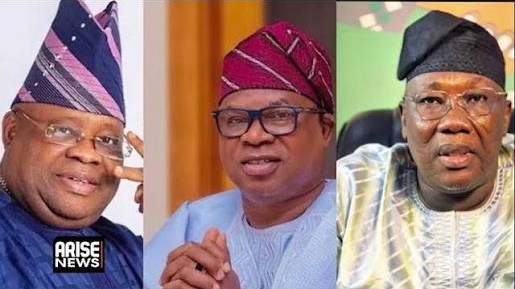
The contest is expected to attract significant attention, particularly with incumbent Governor Ademola Adeleke seeking another term while the All Progressives Congress (APC) has presented Bola Oyebamiji as its candidate. The emergence of Najeem Salaam on the platform of the African Democratic Congress (ADC) has also introduced another major political variable.
With the contest increasingly taking the shape of a three-way battle, several factors could determine who eventually succeeds at the Osun Government House.
- Adeleke’s Performance and Incumbency Advantage
Governor Ademola Adeleke will enter the election with the advantage of incumbency.
His administration will be expected to campaign on projects, policies and achievements recorded since assuming office, particularly in infrastructure, education, workers’ welfare, healthcare and other sectors.
However, incumbency alone may not guarantee victory.
The crucial issue will be whether voters believe the administration has performed sufficiently to deserve another four years.
Adeleke will therefore need to convince voters that his administration has delivered on its promises and that continuity would be in the best interest of the state.
- APC’s Federal Connection and Political Structure
The APC is expected to rely heavily on its extensive grassroots organisation and the influence of the Federal Government.
Its candidate, Bola Oyebamiji, is a former Commissioner for Finance in Osun State and has experience within the state’s political establishment.
The APC’s challenge will be to translate its national influence and party structure into actual votes at the ward and polling-unit levels.
The party must also overcome the advantage enjoyed by an incumbent who already has access to the visibility and political structures associated with occupying the state executive office.
- The ADC Factor and Aregbesola’s Influence
The emergence of Najeem Salaam as the ADC candidate has added another dimension to the election.
Salaam, a former Speaker of the Osun State House of Assembly, is associated with former Governor Rauf Aregbesola, whose political influence remains an important factor in Osun politics.
The ADC’s performance could have a significant impact on the final outcome, particularly if it succeeds in attracting voters who are dissatisfied with both the APC and the ruling Peoples Democratic Party (PDP).
One of the biggest questions ahead of the election is whether the ADC can transform its growing political presence into a statewide electoral coalition.
- Grassroots Mobilisation and Ward-Level Structures
Osun is not a state where social-media popularity alone can determine an election.
The ability of the three major camps to mobilise supporters at the grassroots will be crucial.
Political parties will have to work beyond major rallies and media campaigns by maintaining effective structures across local government areas, wards and polling units.
The candidate capable of turning political enthusiasm into actual voter turnout could gain a major advantage on election day.
This makes grassroots mobilisation, party loyalty and polling-unit organisation potentially decisive factors.
- Vote Splitting and Voter Turnout
Perhaps the most unpredictable factor is how votes will be distributed among the major candidates.
If the contest remains closely divided among Adeleke, Oyebamiji and Salaam, the eventual winner could emerge with a relatively narrow margin.
The ADC’s presence could particularly affect the traditional APC-PDP rivalry by attracting voters from either camp.
Voter turnout will also be critical. Strong support in opinion polls or on social media means little if supporters fail to turn out on election day.
The ability to mobilise voters in areas where each candidate enjoys strong support could therefore determine the final result.
A Three-Way Battle With No Room for Complacency
The Osun 2026 governorship election is increasingly shaping up as a contest between incumbency, federal political machinery and a potential third force.
For Adeleke, the challenge is to convince voters that his first-term performance deserves continuity.
For Oyebamiji and the APC, the task is to convert the party’s structure and federal influence into sufficient grassroots support to defeat the incumbent.
For Salaam and the ADC, the challenge is to prove that the party can break the traditional PDP-APC dominance and build a coalition capable of winning statewide.
Ultimately, performance, personality, grassroots mobilisation, party structure, voter turnout and vote splitting could determine who emerges victorious.
With the political temperature rising, Osun may be heading for one of its most closely watched governorship contests in recent years.