The recent exit of Peter Obi from the African Democratic Congress (ADC) has continued to stir political debate, particularly following his reference to “state agents” influencing internal party dynamics—a remark that has triggered widespread speculation across Nigeria’s political landscape.
While unverified claims on social media have attempted to link Obi’s departure to the alleged involvement of three former Nigerian presidents, there is no credible evidence supporting such assertions. Instead, a closer examination of Obi’s statement and the evolving situation within the party suggests a more complex interplay of institutional pressure and internal instability.
Obi’s Position: A System Under Pressure
In his official remarks, Obi pointed to what he described as a “toxic political environment”, citing persistent internal crises, leadership tussles, and a growing pattern of external interference. His mention of “state agents” has been widely interpreted within political circles as a reference to:
Security and intelligence apparatus allegedly influencing party affairs
Regulatory institutions exerting pressure through legal and administrative channels
Political power brokers aligned with the ruling establishment
Although Obi stopped short of naming specific individuals or offices, analysts believe his comments reflect a broader concern about state-backed political engineering, a recurring issue in Nigeria’s democratic process.
ADC’s Internal Crisis
The crisis within the ADC has been building over time, particularly following leadership disputes involving figures such as David Mark. Court cases, factional divisions, and disagreements over party structure have weakened cohesion, creating an environment that insiders describe as “unsustainable” for long-term political engagement.
Obi’s exit, therefore, appears to be less about personalities and more about structural dysfunction compounded by external pressure.
The “Ex-Presidents” Narrative: Fact or Fiction?
Despite the traction gained online, the claim that three former presidents orchestrated Obi’s departure remains purely speculative. No mainstream or credible media organization has substantiated this narrative, and Obi himself has not alluded to any such involvement.
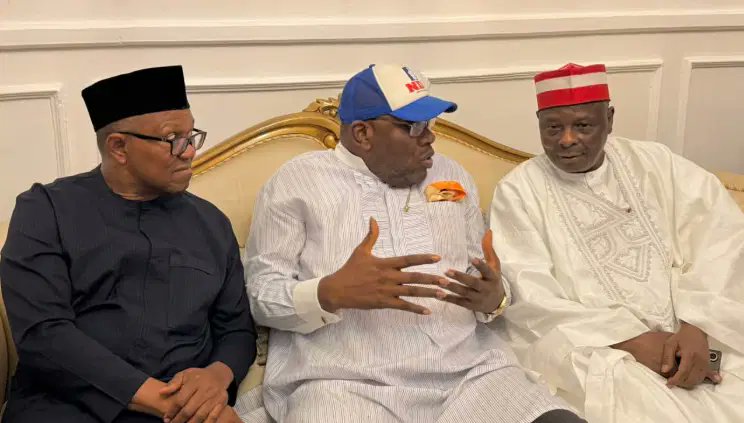
Political observers suggest the theory may be part of:
Disinformation campaigns aimed at shaping public perception
Attempts to frame Obi’s exit within a broader elite conspiracy narrative
Misinterpretation of his reference to “state agents”
Broader Implications for 2027
Obi’s departure raises critical questions about the integrity of opposition politics ahead of the 2027 general elections. If claims of state interference hold weight, it could signal:
A shrinking space for independent political actors
Increased difficulty for opposition parties to consolidate
Heightened voter skepticism about electoral fairness
Conclusion
While the full extent of the “state agents” influence remains unclear, what is evident is that Obi’s exit underscores deeper systemic challenges within Nigeria’s political framework. For now, the narrative linking his decision to former presidents lacks factual grounding, but the conversation it has sparked points to a larger issue—the role of power, control, and institutional influence in shaping political outcomes.
As events continue to unfold, all eyes will be on Obi’s next move and how the opposition repositions itself in an increasingly contested political terrain.