As Nigeria gradually moves towards the 2027 general elections, the political landscape is becoming clearer as major political parties conclude their presidential primaries and present candidates for the nation’s apex political office.
The race is already shaping up to be one of the most competitive contests in Nigeria’s democratic history, with incumbent President Bola Ahmed Tinubu seeking re-election, former Vice President Atiku Abubakar mounting another challenge, former Anambra State Governor Peter Obi leading a new political movement, and several other notable contenders offering alternative visions for the country.
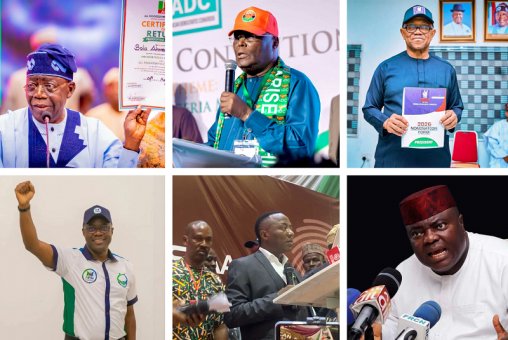
With issues such as economic hardship, insecurity, unemployment, inflation, electricity supply, constitutional reforms, and governance dominating public discourse, Nigerians are preparing for another defining electoral battle.
Bola Ahmed Tinubu (APC)
Bola Ahmed Tinubu is the presidential candidate of the ruling All Progressives Congress.
Born on March 29, 1952, Tinubu served as Governor of Lagos State between 1999 and 2007 before emerging President of Nigeria in the 2023 general election. Widely regarded as one of Nigeria’s most influential political strategists, he is seeking a second and final term in office.
His campaign is expected to focus on consolidating ongoing economic reforms, infrastructure development, security improvements, fiscal restructuring, and strengthening Nigeria’s revenue base.
Atiku Abubakar (ADC)
Former Vice President Atiku Abubakar emerged as the presidential candidate of the African Democratic Congress after winning the party’s primary election.
Born on November 25, 1946, Atiku served as Vice President between 1999 and 2007 under former President Olusegun Obasanjo. He remains one of Nigeria’s most recognizable political figures and is making another bid for the presidency.
His campaign message is expected to revolve around economic recovery, private-sector growth, national unity, constitutional reforms, and strengthening democratic institutions.
Peter Obi (NDC)
Former Anambra State Governor Peter Obi is expected to lead the challenge of the Nigeria Democratic Congress following his departure from the ADC coalition.
Born on July 19, 1961, Obi gained national prominence during the 2023 presidential election, where he attracted significant support from young voters and urban populations.
Known for advocating prudent management of public resources, transparency, and economic productivity, Obi’s campaign is expected to focus on job creation, education, industrialization, and reducing the cost of governance.
Seyi Makinde (APM)
Governor Seyi Makinde has emerged as one of the most talked-about figures ahead of the 2027 presidential election.
Born on December 25, 1967, Makinde is serving his second term as Governor of Oyo State and has built a reputation around infrastructure development, education reforms, agribusiness expansion, and fiscal discipline.
Although his political future remains a subject of intense speculation, Makinde has publicly indicated interest in seeking the presidency. Political observers view him as one of the younger and more reform-minded politicians capable of attracting support across regional and generational lines. However, his path to the presidency will depend largely on coalition-building and party dynamics.
Adewole Adebayo (SDP)
Adewole Adebayo is the presidential candidate of the Social Democratic Party for the 2027 election.
A lawyer, businessman, and public affairs commentator, Adebayo first gained national attention as the SDP presidential candidate in the 2023 election. He emerged again as the party’s flag bearer after being adopted as the sole aspirant during the SDP national convention in Bauchi.
Adebayo has consistently advocated for good governance, economic justice, constitutional restructuring, industrial development, and improved social welfare policies. His campaign is expected to focus heavily on addressing poverty, unemployment, insecurity, and institutional inefficiency.
Donald Duke (PRP)
Former Cross River State Governor Donald Duke is the presidential candidate of the Peoples Redemption Party.
Duke governed Cross River State between 1999 and 2007 and remains widely known for promoting tourism, environmental sustainability, and infrastructure development.
His political agenda emphasizes economic diversification, tourism development, youth empowerment, and efficient public administration.
Omoyele Sowore (AAC)
Human rights activist and publisher Omoyele Sowore is representing the African Action Congress.
The founder of Sahara Reporters has built his political profile around anti-corruption advocacy, transparency, youth participation, and social justice.
Sowore remains one of the most outspoken critics of Nigeria’s political establishment and is expected to campaign vigorously on governance reforms and accountability.
What to Expect in 2027
Political analysts believe the 2027 presidential election may evolve into a multi-candidate contest involving Tinubu, Atiku, Obi, Makinde, Adebayo, and other emerging contenders.
Key issues expected to dominate campaigns include:
- Economic growth and inflation control
- Job creation and youth empowerment
- Security and national stability
- Education and healthcare reforms
- Electricity and infrastructure development
- Constitutional and electoral reforms
- Cost of governance and public accountability
The election will also test the strength of political alliances, opposition coalitions, and the ability of smaller parties to influence the outcome of the national vote.
As parties prepare for full-scale campaigns and submit final nominations to INEC, Nigerians are set for another historic democratic exercise that could significantly shape the country’s political and economic future.
Editor’s Note: As of May 2026, Atiku Abubakar has emerged as ADC’s presidential candidate, while Adewole Adebayo has been formally submitted by the SDP as its presidential candidate for the 2027 election.